Saturday, June 23, 2007

Moved to www.sportinc.wordpress.com

Attempting to consolidate my various blogs into one single site... now at www.sportinc.wordpress.com

Thursday, June 14, 2007

Anger vs Peace

"For every minute you remain angry, you give up sixty seconds of peace of mind."
Ralph Waldo Emerson

Friday, June 08, 2007

Alternative perspective on competition

"There is competition, but it is used in a good way. It is positive to want to go first, provided the intention is to pave the way for others, make their path more easy, help them, or show the way. Competition is negative when we wish to defeat others, to bring them down in order to lift ourselves up."

~ His Holiness The Dalai Lama

p.s. Thanks for this Tara.

Tuesday, June 05, 2007

The True Meaning Of Life

The True Meaning Of Life

"We are visitors on this planet
We are here for ninety or one hundred years at the very most.
During that period, we must try to do something good, something useful, with our lives.
If you contribute to other people's happiness, you will find the true goal, the true meaning of life"

H.H. The 14th Dalai Lama

This post is dedicated to our new friend Paul Garden who gave me the t-shirt he was wearing! The phase above was from the t-shirt he offered me.

Today 5 June is World Enviroment Day 2007


Various events happening around the world and here in Singapore, Ricoh and the Singapore Environment Council (SEC), will have an event on 5 June titled THINK AND ACT - Eco Action. The goal of the event will be to conserve energy consumption and spread awareness for energy conservation and climate change among people in Singapore. The participating organizations will do this by switching off office lights and sign boards at the office closing time.
For more information, please contact:
Masayo Hada
Ricoh Asia Pacific
260 Orchard Road #15-01/02
The Heeren
Singapore
Tel: 65 6830 5762
E-mail: masayo_hada@rapp.ricoh.com
Website: www.ricoh.com.sg/about/environment.aspx

There's also a pinic organizsed by Nature Society of Singapore tomorrow Wed 6 June 2007 at Sentosa.
Title: KIDS CELEBRATE WORLD ENVIRONMENT DAY:
World Environment Day Picnic at Sentosa
Date: Wed 6 Jun 2007
Time: 10.30am
Location: Sentosa
Meeting Point: Ficus Station, Sentosa
Registration Closing Date: 25 May


World Environment Day Picnic at Sentosa
Come have fun and picnic under an awesome heritage fig tree! Learn all about fig trees and animals that make these trees home. Find out how figs grow, what’s inside a fig, who eats figs, etc. Suitable for kids aged 5 to 9. Meet at Sentosa’s Ficus Station at 10.30am (tip: Park at Vivocity and take the train to Ficus Station). You will need a picnic mat, binoculars, comfortable walking shoes, light cotton clothing, water, your picnic meal and snacks, and herbal insect repellent. Registration is required.

To register, e-mail Vilma at vilma.drozario@nie.edu.sg and Zaki at bpelari@yahoo.com by 25 May 2007.

Doesn't look like I'll be able to make any of these activities. However, I made myself a personal promise, renewed my "vows" so to speak, to continue my goal of being environmentally friendly in my life. Let's love Mother Earth.

About World Environment Day 2007
World Environment Day, commemorated each year on 5 June, is one of the principal vehicles through which the United Nations stimulates worldwide awareness of the environment and enhances political attention and action.

Thursday, December 07, 2006

**DO SOMETHING GOOD THIS HOLIDAY SEASON** Join us and donate a little to UNIFEM this Christmas

Another year gone by... Another year of memories... 2006 was full of great surprises and exciting changes... of course, what's life without its many challenges. 2006 was a special year of self discovery - I became particularly "enlightened" about the amount of suffering in the World. And I thank my better half N for being so compassionate to those less fortunate and influencing me for the better.

N & I are now even more committed to doing our part for the less fortunate. N recently came out to the public as a spokesperson for UNIFEM Singapore on violence against women - she had a personal message as she was previously abused by her Exs.

We really like and support what UNIFEM is doing here in Southeast Asia (UNIFEM's ongoing projects) and we have decided to donate and contribute a little something to the UNIFEM Livelihood Facility Fund (helping women and children in Aceh - I was particularly delighted to know that 80% of my money goes directly into the fund! See below and also click here .

WE HOPE YOU WILL JOIN US IN GIVING AND SHARING A LITTLE FOR THOSE LESS FORTUNATE THIS HOLIDAY SEASON - CLICK HERE TO DONATE THROUGH PAYPAL/CREDIT CARDS OR JUST SEND A CHEQUE DIRECTLY. unifem donate


Here's wishing you and your loved ones a Holiday Season filled with lots of joy, love and happiness. And to a Sparkling NEW YEAR!
________________________
UNIFEM Livelihood Facility Fund for Aceh
To date UNIFEM has assisted 450 women by providing seed money for Acehnese women to start their own business in order to create a sustainable source of livelihood for themselves and their children. As an old Chinese saying goes - Give a man a fish and you feed him for a day. Teach a man to fish and you feed him for a lifetime. UNIFEM is currently running these programmes for the women because development aid has been only given to head of households i.e in this context to the men only. However many women were widowed and most are also supporting children of their relatives that lost their lives after the tsunami.

Singapore has strict laws on the percentage of fund to be remitted overseas (the law stands at 20% overseas and 80% have to remain in Singapore). However UNIFEM Singapore has received permission enable to organization to remit 80% of the funds overseas with 20% remaining in Singapore. Of which 5%-10% is usually directed to campaigns to raise public awareness about the issues and the remaining to run the office. UNIFEM Singapore runs a very modest operation with only 2 staff and a small set up.

Please feel free to contact Fazlin Abdullah at +65 62386761 or fazlin@unifemsingapore.org.sg should you have further questions or would like to have a look at the audit carried out by Ernst and Young.

COMING NEXT: Anti human trafficking programme in the greater Mekong region

Year End Retrospection....

Every year in December I look back at the year and reflect on my achievements for the year. And it was rather coincidental that I came across the following passage just the other day. I thought it was simple yet powerful.

.................
To know what you want to have achieved by the end of this life, do some introspection and 'retrospection.'

What do you want to have on your mind on your deathbed?

Any last wishes?
Why not fulfil them now?

Any last regrets?
Why not resolve them now?

Time is not on our side.
We are running out of it.
.................

It's About Time to Make a Real Change on the Penal Code Amendment on Marital RAPE!

GUYS. HEY GUYS. Watch here - check it out! We are real gentlemen and it's time to support this cause. Real men treat women right.
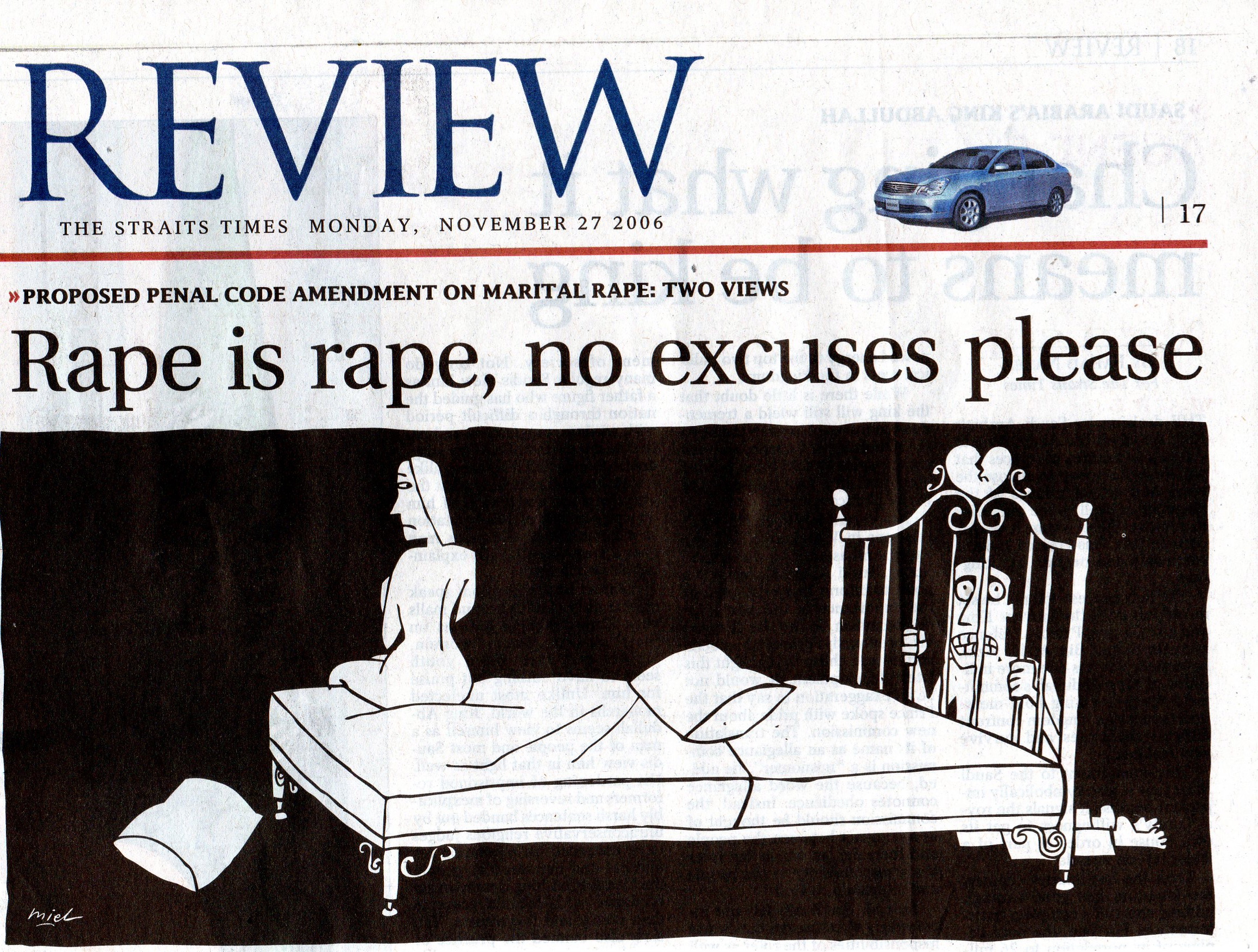
I met Leigh at Oxford University about 10 years ago and she was a smart cookie. We were both doing our Masters degrees then and I lost touch with her for quite a number of years until I ran into her again at the Unifem Snow Dinner a few weeks ago. It was good to see what she was up to these days (see recent Straitstimes articles) and the good stuff she's doing as Director of the Singapore Institute of International Affairs. Well done - keep it up.


Saturday, November 25, 2006

25 Nov is International Day to End Violence Against Women

Nicole Kidman UNIFEM

Today 25th Nov is International Day for the Elimination of Violence Against Women.

Not A Minute More - "International Day to End Violence Against Women"

Concert: Join us on Saturday November 25th at Clarke Quay (Fountain Area) from 3pm-7pm as we commemorate International Day to End Violence Against Women.

Activities Include: Children's art competition – "draw your favourite woman", face painting by celebrities, "adopt-a-flower" with entertainment by -

Top local bands - Sea Bed Sound, You and Whose Army?, Scoriac Sky, AM in the Morning, Doll Trash, Nuradee Brothers, Vivid, Nu Beat Alley, Bollywood Dance Performance, Embryo, Krueger and Fatskunks.

Celebrities - Aaron Aziz, Annabelle Francis, Andrea D'Cruz, Nadya Hutagalung, Amy Cheng.... I'll be there to support this cause as well!

Also see what happens to Anna of www.helpanna.com and check out the good things that the Singapore Unifem National Committee does.

Looking forward to seeing all of you there!


GUYS, WE CAN ALL PLAY A PART. IT'S JUST NOT COOL TO HURT WOMEN.
Here's a suggestion: CHANNEL YOUR ENERGIES INTO SPORTS! HELP STOP THE SUFFERING OF WOMEN. These are mothers, wives and daughters.

Saturday, November 18, 2006

Alternative Energy: Green dreams

Cover of this week's Economist. Latest craze? Investing in Alternative Energy - "great for society, but perhaps not so for investors?"
__________________________________________________________
LEADERS

Alternative energy

Green dreams
Nov 16th 2006 From The Economist print edition

The flood of money into clean energy is better news for society than it is for investors


COMPUTER chips and solar panels are made of the same basic stuff: thinly sliced silicon. Until recently, however, Silicon Valley did not take much interest in the alternative use of its principal raw material.

That has changed. California's entrepreneurs are piling into clean-energy technology. In June a group of Silicon Valley luminaries invested $100m in Nanosolar, a firm which hopes to cut the cost of producing solar panels dramatically. The investors include some of the founders of eBay, the world's biggest online auctioneer, and Germany's SAP, a giant software firm. Nanosolar's seed money came from Sergey Brin and Larry Page, who started Google. Last month their “do no evil” search-engine company announced plans to build the largest corporate solar-power installation at its Silicon Valley campus. The panels will supply about 30% of its electricity.

One estimate puts the total investment going into clean energy at $63 billion this year, up from $49 billion last year and just $30 billion in 2004. Some supposedly green business is more relabelling than revolution—companies flogging slightly more efficient versions of standard technologies as exciting innovations—but there is also a flood of money into new energy technologies. Clean energy now gobbles up almost a tenth of America's venture capital. After years of wondering what would be the next big thing after the dotcom boom, America's technology industry is betting on alternative energy (see article).

This is excellent news for society. More private-sector investment in green technologies will mean cheaper clean energy, lower fossil-fuel consumption and a greater chance of averting serious climate-change. It may not, however, be such good news for investors.

Déjà vu all over again

Displays of excessive enthusiasm for particular new technologies often end in tears. In the late 1990s, investors poured money into telecoms firms and dotcom start-ups. Some of the wild claims made at the time proved to be justified eventually, but not before around $1 trillion of value had been destroyed and many investors had lost their shirts.

The comparison is inexact. Nothing like as much money is going into clean energy as went into telecoms and internet firms. And there are solid, long-term reasons to expect demand for clean energy to grow. Governments do not want to rely on faraway, unstable or downright hostile countries for oil and gas. They are also increasingly concerned about pollution, especially in the form of the greenhouse gases that cause global warming. Most importantly, high fossil-fuel prices make alternatives look far more affordable and attractive.

Clean energy is also getting cheaper. The cost of wind-power generation has come down from 8-10 cents to 3.5-4 cents per kWh since 1990 because of better turbines and higher volumes. Solar-power prices have dropped too. The first cells, in satellites, cost about $200 per watt of generating power. By last year the price had fallen to about $2.70 per watt. The more money goes into the sector, the faster prices will fall.

But although the price gap between electricity generated by fossil fuels and that generated by alternatives has shrunk, it still exists. Making biodiesel remains more expensive than producing the non-bio sort. Burning natural gas is still a cheaper way of generating power than using wind turbines. And coal, the dirtiest of all energy sources, is still by far the cheapest. For the time being, clean energy is competitive in only a few countries in certain specific instances: solar power for retail electricity consumers in Japan, say, or ethanol made from sugarcane in Brazil. The sort of advances that will really change the world, such as ethanol that can be made cheaply from grass or trees, or solar cells that can be painted onto almost any surface, remain a distant prospect.

Almost all clean energy therefore relies on government subsidies to make it competitive with fossil fuels. For the moment, politicians seem quite happy to pay up. No fewer than 49 governments, according to Goldman Sachs, an investment bank, have established targets to promote greater use of renewable energy sources: the voters pay, either through higher prices or through direct subsidies.

So hip, so hot, so green

As far as voters are concerned, this is probably a reasonably good use of public money. Climate change is a real problem and the only way to tackle it is to reduce the gap between the price of fossil-fuel energy and alternative energy. But subsidies are not the best way to achieve that goal. Governments that try to pick winners often choose losers. Subsidies distort investment: since the German government fixed the price for solar power at munificent levels, the country has been sucking in huge numbers of solar panels that could be put to better use in sunnier climes. A global carbon tax would be a more efficient way to close the price gap between fossil and alternative fuels. But that solution is a long way off. In the meantime, subsidies for alternatives are probably better than no action.

That's true for voters. But government subsidy is a wobbly foundation on which to build a business. Politicians are a fickle lot. Environmentalism is hot right now: it even featured on a recent cover of Vanity Fair, with Julia Roberts as a green fairy, George Clooney fetchingly attired in peasant gear and Al Gore brooding earthily. But fashions fade, and voters may begin to question the logic of certain subsidies as ever more firms take advantage of them and the bills begin to rise. As it is, the industry's fortunes rise and fall with the level of official largesse. Wind power in America, for example, inflates and deflates on a two-year cycle, as a particular tax credit is renewed and then lapses again.

Society should rejoice that greenery is in vogue. Markets too will over the long term come to value the technologies in which the clean-energy business is investing. In the short term, though, the prospects of a business so dependent on the whims of politicians are bound to be uncertain. Some investors are sure to see their shirts blown away in the wind.

Tuesday, October 24, 2006

More on Muhammad Yunus - Noble Peace Prize Winner 2006

The more I read about him, the more I realize what amazing things he has done for the poor and the people of Bangladesh. What compassion!

macro credit economist

Face value
Macro credit


Oct 19th 2006
From The Economist print edition


Muhammad Yunus has won the Nobel peace prize for his role in promoting financial services for the poor
AFP

FOR many of the supporters of Muhammad Yunus and the institution he created, the Grameen Bank of Bangladesh, the announcement that the two will share a Nobel peace prize is long overdue—the only surprise is that it was so long in coming. Grameen's website lists 60 awards, 27 honorary degrees, and 15 other “special honours” previously received by Mr Yunus directly, and seven received by Grameen. The selection committee said the prize was for developing what “had appeared to be an impossible idea”, namely loans to people who lack collateral.

Mr Yunus has unquestionably helped create an industry that provides financial services to the poor, combining his experience of growing up in a small village with his academic background as an economist to popularise what was once just a fringe area of banking and an obscure idea about alleviating poverty. Grameen has become a sizeable institution, with 6.7m customers, most of them women and all of them poor. Grameen has, by its own reckoning, distributed $6 billion in loans, each on average less than $200. Dressed in a traditional Bangladeshi outfit made by a Grameen affiliate, the charismatic Mr Yunus, with his soft voice and warm smile, can transform the dry, grinding mechanics of banking into a bewitching story about beggars, children and empowered women, all benefiting from credit that should be a human right and could even, he says, end poverty.

Even so, loans to the poor have existed for thousands of years. The formalised system of small borrowing that Mr Yunus pushed in Bangladesh beginning in the mid-1970s was being tried in bits and pieces around the world at the same time, and earlier as well. Even in Bangladesh, where his award was warmly received as an international endorsement, there are two other equally large and innovative microfinance institutions: BRAC, which dates back to the same era as Grameen, and ASA, which came later but improved on the basic model. Yet as remarkable as these three are, to single them out is, in a sense, unfair. There are thousands of financial institutions around the world providing financial services to the very poor. It is a world of extraordinary individuals, and one that has advanced as a result of collective insights. Physics and chemistry, to cite two other Nobel categories, may be built upon the shoulders of a few giants, but microfinance needs—and has—thousands of them.

Mr Yunus and Grameen succeeded by seizing an idea, expanding quickly, proselytising and resisting the temptation to move beyond the poor. His particular approach to microfinance has not, however, been without controversy. By legend, Grameen grew out of a $27 loan Mr Yunus made in 1974 to a woman manufacturing furniture who did have credit, but at an exorbitant price. Grameen emerged soon thereafter, based on several key operational techniques: loans were made to individuals but through small groups who in effect (if not explicitly) had joint liability; the loans were for business, not consumption; and collection was frequent, usually weekly. Interest charges were significant—the money was not aid, and a fundamental tenet of Grameen is that the poor are creditworthy—but the rates were relatively low (currently just above 20%).

This approach had virtues and limitations. Low rates and lower savings (except as a back-up for repayment) meant that in its early years, Grameen relied on capital from public and private donors—something that less charismatic or connected entrepreneurs than Mr Yunus found hard to replicate. Joint liability for loans became an increasing problem for groups when some members wanted to borrow more than others. And it was unclear whether the money received really did always go to business, rather than daily needs. A deeper question is just how helpful such tiny loans really are. Heart-warming case studies abound, but rigorous analyses are rare. The few studies that have been done suggest that small loans are beneficial, but not dramatically so. A further question is whether an approach emphasising credit really can eradicate poverty: a ridiculously ambitious goal, though one that Mr Yunus's evangelical view of the virtues of credit has perpetuated. Whether this form of lending has led to peace, the presumptive reasoning behind the award, is just as big an unanswered question.

Credit where credit's due
The classic Grameen model began to fray in the 1990s and hit a wall in 1998, when a devastating flood pushed up losses and people began missing weekly payment meetings. Mr Yunus was no doubt familiar with microfinance innovations in other countries: BRI in Indonesia had transformed itself from a wreck into a huge success by emphasising savings, not credit, and other institutions had started to abandon group lending. Grameen restructured in 2001, emphasising savings (deposits now exceed loans) and relying less on joint liability for groups.

With Grameen now thriving and the Nobel on the shelf, what will Mr Yunus do next? There are persistent rumours that he might enter politics, given his prestige within Bangladesh. And this could be a good time for him to step away from microfinance, which appears to be at an inflection point. Institutions continue to emerge and grow, many funded by private capital and seeking a real return, an approach Mr Yunus opposes. They often begin by charging higher rates than Mr Yunus considers legitimate, but cut prices when their returns draw competitors—a tough but theoretically more supple model. Microfinance would also benefit from a voluntary regulatory structure to improve its access to capital, and greater use of technology to reduce transaction costs. What it needs, in short, are the boring, quiet innovations that dynamic industries depend upon, but which, alas, do not win prizes. The Nobel, and its recognition of microfinance's most charismatic cheerleader, may mark the end of an era as a more mature industry starts to emerge.

Monday, October 23, 2006

No training in this HAZE! What are we all doing to our earth!

Taken from my main site: www.sportinc.net

So I've avoided swimming and training outsides for the last couple weeks, especially when the PSI goes past 100. But actually I won't go train even when it's about 70-80... I've had to train in the gym or on my indoor bicycle trainer (very useful these days!). We've all gotta do something about this crazy haze. It's all just greed - the easiest fastest cheapest way to clear the land for more Palm Oil plantations in Indonesia!!! Perhaps we should all not invest or direct investment monies in those companies that actually own the Indonesian plantations burn to clear for more PALM OIL crop! Not only does it pollute our earth, it's killing the natural habitat of the Orang Utans - click here and download the March 2006 issue of Elements produced by the Singapore Environmental Council. It's just sad.
elements005
Anyway, we all can play our own little part in respecting the environment.

Following in my previous 10 things mantra.... here's another 10 for our mother earth (and the next generations!)
10 Eco things to do
Here are 10 simple ways YOU can help stop global warming

1) Change a light bulb
Replacing one regular light bulb with a compact fluorescent light bulb
can save 130kg of carbon dioxide (CO²) and $50 a year.
Solution: Compact fluorescent light bulbs are available at IKEA: $5-$8 depending on size

2) Drive less, drive a hybrid car or install a compressed natural gas car kit
in your current car so it can run on petrol or compressed natural gas.
Solution: kits are available at www.cng.com.sg for approximately $2000

3) Walk, cycle, carpool or use public transportation more often
public transportation can save 4,200kg of CO² and you $2,500 per year.
Solutions:
The bike boutique will lodge your bike while you work, $ 10 p/d, $150 p/m
http://www.carcoop.com.sg;
http://www.whizzcar.com

4) Recycle More
Save 1090 kg of CO² per year by recycling your household waste
Solutions: Ask for a recycle bin, call NEA 1 800 225 5632 (24 hr. hot line)
Recycled paper is available from A’zone; Tel:65454800; azone@starhub.net.sg

5) Use less hot water
You can save 450kg of CO² and $150 per year.
Solution: Wash your clothes in cold or warm water & dry them under the sun.

6) Avoid products with a lot of packaging
You can save 545 kg of carbon dioxide if you cut down your garbage by 10%
Solution: Reject plastic and paper bags; use a reusable fabric bag, take it with you when you shop. Available at Cold Storage, Carrefour, NTUC from $1-$5

7) Adjust your thermostat
Setting your air-conditioner at 25°C can save 900kg of carbon dioxide (CO²)
and $300 per year without compromising on cooling comfort.
Solution: Only buy an A/C that has an Energy Label; www.nccc.gov.sg/energylabel/aircon.asp

8) Use an electric fan
You can save 1,400kg of CO² & $500 per year by using electric fan instead of A/C

9) Plant a tree anywhere
A single tree will absorb 1 ton of CO² over its life time
Solution: Go to any nursery at upper Thomson Rd or www.plant-a-tree-today.org

10) Turn off your electronic devices at the main power switch
You can save 250kg of CO² and $100 per year.
Solution: Turn off lights, appliances and electronic equipment, when they are not in use.

AND VERY IMPORTANTLY - Tell a friend to see the movie “An Inconvenient truth”
Golden village tickets range from $6-$9.50.

Do your part! Log on to: http://www.stopglobingwarming.org and www.climatecrisis.net

CLICK HERE TO WATCH A SHORT CLIP OF "AN INCONVENIENT TRUTH" MOVIE - I for sure wish to continue my outdoor activities and enjoy nature. Let's all play our part.
an inconvenient truth
Taken from
The Campaign 4 An Inconvenient Truth (Singapore)
environmental challenge organisation (Singapore)

Poverty

Each and everyone of us can help. Let's start with a simple change in mindset.
This is real suffering and we can all do our part to eliminate poverty.

Sunday, October 22, 2006

"Banker To The Poor" - An inspiration to me (and all bankers!)


The Nobel Peace Prize for 2006 (Press Release)
The Norwegian Nobel Committee has decided to award the Nobel Peace Prize for 2006, divided into two equal parts, to Muhammad Yunus and Grameen Bank for their efforts to create economic and social development from below. Lasting peace can not be achieved unless large population groups find ways in which to break out of poverty. Micro-credit is one such means. Development from below also serves to advance democracy and human rights.

Muhammad Yunus has shown himself to be a leader who has managed to translate visions into practical action for the benefit of millions of people, not only in Bangladesh, but also in many other countries. Loans to poor people without any financial security had appeared to be an impossible idea. From modest beginnings three decades ago, Yunus has, first and foremost through Grameen Bank, developed micro-credit into an ever more important instrument in the struggle against poverty. Grameen Bank has been a source of ideas and models for the many institutions in the field of micro-credit that have sprung up around the world.

Every single individual on earth has both the potential and the right to live a decent life. Across cultures and civilizations, Yunus and Grameen Bank have shown that even the poorest of the poor can work to bring about their own development.

Micro-credit has proved to be an important liberating force in societies where women in particular have to struggle against repressive social and economic conditions. Economic growth and political democracy can not achieve their full potential unless the female half of humanity participates on an equal footing with the male.

Yunus's long-term vision is to eliminate poverty in the world. That vision can not be realised by means of micro-credit alone. But Muhammad Yunus and Grameen Bank have shown that, in the continuing efforts to achieve it, micro-credit must play a major part.

Oslo, 13 October 2006

WHAT EXACTLY IS MICROCREDIT?
The word "microcredit" did not exist before the seventies. Now it has become a buzz-word among the development practitioners. In the process, the word has been imputed to mean everything to everybody. No one now gets shocked if somebody uses the term "microcredit" to mean agricultural credit, or rural credit, or cooperative credit, or consumer credit, credit from the savings and loan associations, or from credit unions, or from money lenders. When someone claims microcredit has a thousand year history, or a hundred year history, nobody finds it as an exciting piece of historical information. Click here for full piece

Thursday, October 19, 2006

My current read "The End of Poverty"

It's strange what I notice these days... I guess I notice what I wish to notice and reality is what I perceive it to be. I strolled into the airport bookstore a few days ago and this book jumped out at me. And after reading just a few chapters, I must say that it is truly revealing and just wakes me up. Imagine waking up EVERY morning to the following headlines: "20,000 people died of extreme poverty yesterday." We can ALL help!

the end of poverty"The End of Poverty" by Jeffrey Sachs

Editorial Reviews

Amazon.com
Celebrated economist Jeffrey Sachs has a plan to eliminate extreme poverty around the world by 2025. If you think that is too ambitious or wildly unrealistic, you need to read this book. His focus is on the one billion poorest individuals around the world who are caught in a poverty trap of disease, physical isolation, environmental stress, political instability, and lack of access to capital, technology, medicine, and education. The goal is to help these people reach the first rung on the "ladder of economic development" so they can rise above mere subsistence level and achieve some control over their economic futures and their lives. To do this, Sachs proposes nine specific steps, which he explains in great detail in The End of Poverty. Though his plan certainly requires the help of rich nations, the financial assistance Sachs calls for is surprisingly modest--more than is now provided, but within the bounds of what has been promised in the past. For the U.S., for instance, it would mean raising foreign aid from just 0.14 percent of GNP to 0.7 percent. Sachs does not view such help as a handout but rather an investment in global economic growth that will add to the security of all nations. In presenting his argument, he offers a comprehensive education on global economics, including why globalization should be embraced rather than fought, why international institutions such as the United Nations, International Monetary Fund, and World Bank need to play a strong role in this effort, and the reasons why extreme poverty exists in the midst of great wealth. He also shatters some persistent myths about poor people and shows how developing nations can do more to help themselves.
Despite some crushing statistics, The End of Poverty is a hopeful book. Based on a tremendous amount of data and his own experiences working as an economic advisor to the UN and several individual nations, Sachs makes a strong moral, economic, and political case for why countries and individuals should battle poverty with the same commitment and focus normally reserved for waging war. This important book not only makes the end of poverty seem realistic, but in the best interest of everyone on the planet, rich and poor alike. --Shawn Carkonen

Wednesday, October 18, 2006

Breathing Meditation: Linda Learning (from Mandala Magazine)

Loved this. Simple.
p.s Click on the pictures to read


FOR THE SOUL 2: Ten Things Not To Avoid

It was really encouraging to get such thoughtful comments and feedback from you on my recent post FOR THE SOUL: Ten Things To Avoid. So here's part 2 to this - let me know what you think. Ponder. Reflect. Live.

Ten Things Not To Avoid

If you seek salvation and perfect wisdom, here are ten things not to avoid. For me, it leads to less suffering and more happiness.

The First. Do not avoid ideas, since ideas are light to the mind.

The Second. Do not avoid thinking, since thinking is the means of playing with the truth.

The Third. Do not avoid being honest about your emotions, since honesty about your emotions enables you to control them.

The Fourth. Do not avoid simple comforts, since they are like manure for spiritual growth.

The Fifth. Do not avoid illness and distress, since these are teachers of piety.

The Sixth. Do not avoid enemies, since they remind you of why you have chosen to pursue spiritual growth.

The Seventh. Do not avoid that which cannot be avoided, since that which cannot be avoided is a divine gift.

The Eight. Do not avoid rationality, since in all situations rationality is your best friend.

The Ninth. Do not avoid exercises of body and mind which maintain your health.

The Tenth. Do not avoid planning how to help others.

Dvagpo-Lharje 5

FOR THE SOUL: Ten Things To Be Avoided

Following my morning meditation, I happened to notice a book on my bookshelf which I hadn't looked at for a while - this book had a reading for each day of the year. Today's reading was particularly suited for my current state of mind and wanted to share this with you. I have realized that these are philosophies which lead to less suffering and more happiness in my life.

TEN THINGS TO BE AVOIDED

If you seek salvation and perfect wisdom, you should avoid ten things.

The first. Avoid a teacher whose heart is set on worldly fame and wealth.

The second. Avoid friends and disciples who upset your peace of mind and hinder your spiritual development.

The third. Avoid living in places where there are many neighbours who are liable to annoy and distract you.

The fourth. Avoid gaining your livelihood by means of deceit and theft.

The fifth. Avoid any actions which may upset your peace of mind and hinder your spiritual development.

The sixth. Avoid rowdy or thoughtless bevaviour which will reduce other people's respect for you.

The seventh. Avoid wasting your time with worthless activities.

The eighth. Avoid concealing your own faults, and drawing attention to the fault of others.

The ninth. Avoid any foods, and break any habits, which damage your health.

The tenth. Avoid any attachments which arise from greed.

Dvagpo-Lharje 4

Meditation: Slow down and Enjoy 'Being'

I am borrowing this post from a friend's "dakinidance" blog which I have been reading regularly. I know she would be happy to share this with many more people.

Take a few moments anytime during your day to watch this little meditation clip. CLICK HERE: Enjoy just BEING

Deeper Stuff here!

Thought that it would be best I post my deeper and more philosophical posts and reflections outside of the SPORTinc.NETwork site.